Last updated: 25 November 2026
---ARTICLE---
COSHH penalties for non-compliance: fines, prosecutions and director liability explained
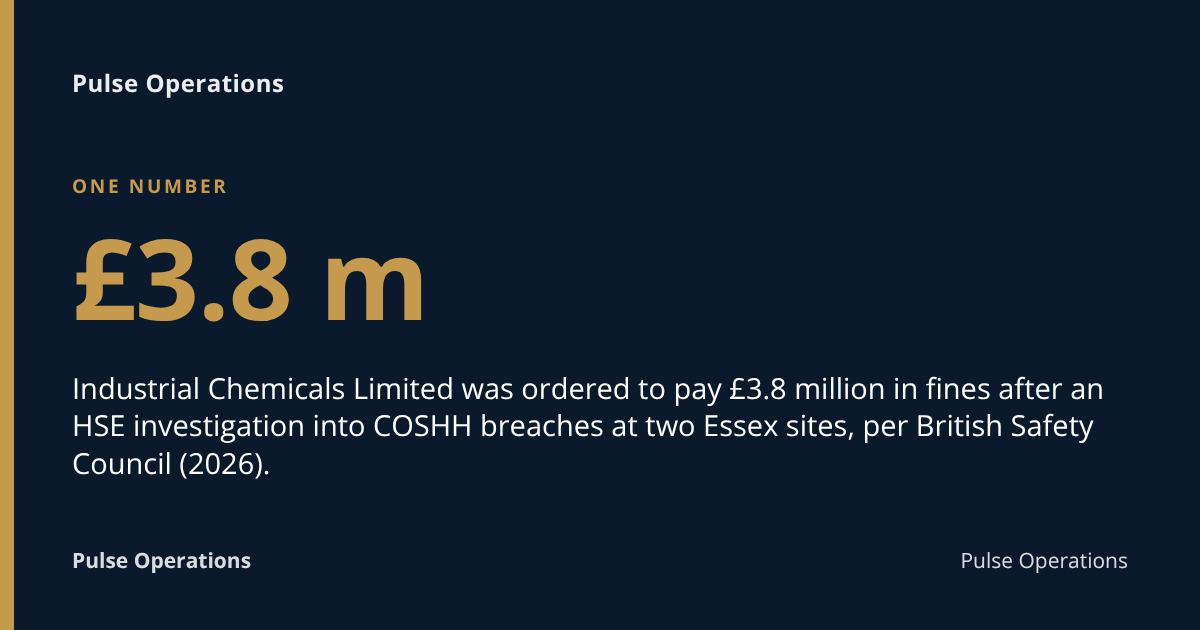
COSHH penalties for non-compliance range from Health and Safety Executive (HSE) improvement notices through to unlimited Crown Court fines and up to two years' imprisonment. Sentencing Council guidelines link fines to turnover, so large organisations have faced penalties up to £10 million, as seen in the £3.8 million fine against Industrial Chemicals Limited for COSHH breaches at two Essex sites, per British Safety Council (2026).
Key Takeaways
- Pulse Operations notes that the Control of Substances Hazardous to Health Regulations 2002 (COSHH) require employers to assess, control and monitor exposure to hazardous substances, with breaches enforced by the HSE under the Health and Safety at Work etc. Act 1974.
- Industrial Chemicals Limited was ordered to pay £3.8 million in fines after an HSE investigation into COSHH breaches at two Essex sites, per British Safety Council (2026).
- Under the Sentencing Council guideline, large organisations with turnover above £50 million could face fines of up to £10 million, per RPC Legal (2016 guideline, still in force).
- The HSE recovered £4.5 million through its Fee for Intervention scheme in 2024/25, charging 5,143 businesses an average of £875 each, per InstallerSHOW (2024/25).
- Around 13,000 UK deaths each year are linked to workplace exposure to hazardous substances, per Safelincs (2025).
What is COSHH and what does it legally require employers to do?
Pulse Operations explains that COSHH is the Control of Substances Hazardous to Health Regulations 2002, a UK statutory instrument (SI 2002/2677) that requires employers to control exposure to substances capable of harming workers' health. It covers chemicals, dusts, fumes, biological agents, and any substance labelled as hazardous under the Classification, Labelling and Packaging (CLP) Regulation.
The regulations sit under the umbrella of the Health and Safety at Work etc. Act 1974, the primary statute the HSE enforces across all UK workplaces. Employers must carry out a COSHH risk assessment, implement controls to prevent or reduce exposure, maintain and test control measures such as extraction systems, provide health surveillance where exposure risk warrants it, and train staff in safe handling.
The HSE publishes detailed guidance on this duty, including its Approved Code of Practice (L5) and A step by step guide to COSHH assessment (HSG97). Its plain-English guide, INDG136, is aimed specifically at small businesses struggling to interpret the legal text.
Around 13,000 UK deaths each year are linked to workplace exposure to hazardous substances, underlining why COSHH carries such serious penalties, per Safelincs (2025). For FM and security operators, this spans cleaning chemicals, legionella risk in water systems, and fuel storage for generators and vehicles — not just heavy industry.
Who is legally responsible for COSHH compliance in a workplace?
The employer holds primary legal responsibility for COSHH compliance, but that duty routes through specific named individuals rather than the company in the abstract. A director, site manager, or duty holder who controls the work is the person the HSE will investigate first.
Pulse Operations points out that under Regulation 10 of COSHH, the employer must assess risks and implement controls; under Section 37 of the Health and Safety at Work etc. Act 1974, any director, manager, secretary or similar officer can be prosecuted personally if an offence was committed with their consent, connivance, or was attributable to their neglect. This applies whether the business is a multinational contractor or a two-person cleaning firm.
In FM and security contracts, responsibility often blurs between the client, the managing agent, and the subcontracted service provider. A cleaning contractor supplying COSHH-regulated products to a shopping centre, for example, remains responsible for training its own staff — but the site operator retains a duty to manage the overall risk under the Management of Health and Safety at Work Regulations 1999. Contracts should state clearly who holds the COSHH assessment for each substance on site, and this is exactly the kind of gap a compliance runway is built to close — tracking which duty holder owns which document, rather than assuming someone else has it covered.
What are the criminal penalties for breaching COSHH regulations?
Criminal penalties for COSHH breaches include unlimited fines in the Crown Court and up to two years' imprisonment for the most serious offences. Magistrates' courts can impose fines for less serious matters, but most substantive COSHH prosecutions are committed to the Crown Court, where fines are unlimited.
The HSE's 2024/25 annual report records 246 completed criminal prosecutions across all enforcement areas, a 96% conviction rate, and fines exceeding £33 million, alongside more than 4,400 enforcement notices — figures covering all HSE enforcement, not COSHH alone, per COSHH Training (2024/25).
Individual case fines illustrate the range. Esken was fined £160,000 and ordered to pay £5,310.35 in costs in May 2024 after pleading guilty to a COSHH offence, per Pinsent Masons (Out-Law) (2024). A manufacturer of household cleaning products was fined £50,000 after an agency worker suffered severe chemical burns to her face, eye, neck and arm, per Opus Safety (2026).
Beyond court fines, the HSE charges businesses directly for its investigation time through the Fee for Intervention (FFI) scheme — cost recovery for inspector hours spent identifying and correcting a material breach. The FFI hourly rate rose from £183 to £188 per hour, effective from 1 April 2026, per IOSH Magazine (2026). In 2024/25, the HSE recovered £4.5 million through FFI, charging 5,143 businesses an average of £875 each — a cost incurred before any court case even begins, per InstallerSHOW (2024/25).
Can directors or managers be personally prosecuted for COSHH breaches?
Yes, directors and managers face personal prosecution under Section 37 of the Health and Safety at Work etc. Act 1974 when a COSHH offence results from their consent, connivance, or neglect. This is separate from any fine levied against the company itself.
Personal prosecution can mean a personal fine, disqualification as a company director under the Company Directors Disqualification Act 1986, or imprisonment in the most serious cases involving reckless disregard for worker safety. HSE Inspector Matthew Dundas has set out the standard the courts expect: "The expected standard is to control exposure to as low a level as is reasonably practicable," per LexisNexis UK.
This standard matters because "reasonably practicable" is a legal test, not a vague aspiration — it requires evidence of what was known, what was available, and what was actually done. A director who can produce dated risk assessments, training records, and maintenance logs for extraction equipment has a defensible position. A director relying on verbal assurances from a site manager does not.
HSE Inspector Nicholas Moreby underlined the seriousness of enforcement following a wood dust prosecution: "The fine imposed on Target Furniture Limited should underline to everyone in the woodworking industry that the courts, and HSE, take a failure to control exposure to harmful substances such as wood dust, and to follow the regulations, extremely seriously," per LexisNexis UK.
How does the Sentencing Council guideline set the size of fines?
The Sentencing Council's definitive guideline for health and safety offences ties fine levels directly to an organisation's annual turnover, assessed alongside culpability and harm severity. This guideline has governed health and safety sentencing in England and Wales since 2016 and remains in force.
| Organisation size | Annual turnover | Maximum fine |
|---|---|---|
| Micro | Under £2 million | Up to £450,000 |
| Small | £2 million–£10 million | Up to £1.6 million |
| Medium | £10 million–£50 million | Up to £4 million |
| Large | £50 million+ | Up to £10 million |
Source: RPC Legal, 2016 guideline (still in force)
Courts first categorise culpability — very high, high, medium, or low — based on whether the breach was deliberate, systemic, or a one-off lapse despite reasonable precautions. They then assess harm by the seriousness of potential injury and the likelihood it would occur, before applying the turnover band to set the final figure. A large organisation with very high culpability and a high likelihood of serious harm sits at the top of its band, near that £10 million ceiling.
This is precisely why Industrial Chemicals Limited's £3.8 million fine sat where it did — a large organisation, serious and repeated breaches, investigated across two separate sites, per British Safety Council (2026).
What enforcement actions can the HSE take before prosecution?
The HSE can issue improvement notices and prohibition notices long before any prosecution begins, giving businesses a chance to correct breaches without a criminal record. An improvement notice requires a specific fix within a set timeframe; a prohibition notice stops dangerous work immediately.
HSE inspectors issue these notices under Sections 21 and 22 of the Health and Safety at Work etc. Act 1974. Failing to comply with a notice is itself a criminal offence, separate from the original COSHH breach, and tends to signal aggravating culpability if the matter does reach court. The HSE's enforcement register is public, and appearing on it carries reputational cost well beyond any fine — a factor that increasingly affects tender eligibility and client confidence in FM and security contracts.
This is where most of the Sentencing Council's harm categorisation actually gets decided in practice. An inspector who finds no COSHH risk assessment, no record of substance reviews, and no evidence of staff training will categorise the breach as systemic rather than incidental — pushing a case toward the higher culpability bands described above, regardless of whether anyone was actually hurt.
What are the most common COSHH compliance mistakes that lead to enforcement action?
The most common COSHH compliance failure the HSE identifies is the absence of a current, substance-specific risk assessment — not simply a generic policy document. Inspectors consistently find assessments that are years out of date, cover substances no longer in use, or were never done at all.
Other recurring failures include:
- No record of control measure maintenance — extraction systems, ventilation, or PPE that are never tested or logged
- Missing health surveillance for workers exposed to substances like respirable dust, despite a legal duty to monitor
- Untrained agency or temporary staff handling hazardous substances without induction — a factor in the £50,000 fine over chemical burns to an agency worker, per Opus Safety (2026)
- No substance inventory, meaning nobody can say what hazardous materials are actually on site
- Verbal rather than documented training, leaving no evidence trail if an inspector asks
For FM and security operators specifically, cleaning chemical storage, legionella control in water tanks, and fuel for backup generators are the substances most often overlooked, because they don't feel like "industrial chemicals" in the way the Essex ICL case or wood dust prosecutions do.
Your COSHH compliance checklist
- Identify every hazardous substance on site and record it in a substance inventory
- Complete a written COSHH risk assessment for each substance, reviewed at least annually
- Record maintenance and testing dates for all control measures, including extraction and ventilation
- Provide documented training for every member of staff, including agency and temporary workers
- Arrange health surveillance where exposure risk is identified
- Retain COSHH records for the periods relevant substances require — some extending to decades for certain carcinogens
- Confirm which party — client, managing agent, or contractor — holds the COSHH assessment for each substance in every service contract
- Audit your evidence trail: if an HSE inspector asked for it today, could you produce it within the hour
FAQ
Can COSHH fines really be unlimited?
Yes, Crown Court fines for COSHH breaches are unlimited, with the actual figure set by the Sentencing Council guideline according to the organisation's turnover, culpability and harm severity. Large organisations with turnover above £50 million could face fines up to £10 million, per RPC Legal (2016 guideline, still in force).
Can you go to prison for breaking COSHH rules?
Yes, the most serious COSHH breaches can result in imprisonment of up to two years, usually reserved for cases involving reckless disregard for worker safety or repeated, deliberate non-compliance. Most prosecutions result in fines rather than custodial sentences, but imprisonment remains a legal possibility under the Health and Safety at Work etc. Act 1974.
Do small businesses have to comply with COSHH regulations?
Yes, COSHH applies to every UK employer regardless of size, including sole traders and small FM or cleaning contractors handling hazardous substances. The Sentencing Council guideline even sets a specific fine band for micro enterprises with turnover under £2 million, capped at £450,000, per RPC Legal (2016 guideline, still in force).
What happens if a workplace doesn't have a COSHH risk assessment?
A workplace without a COSHH risk assessment is in breach of Regulation 10 of the COSHH Regulations 2002 and faces immediate enforcement risk if an HSE inspector visits. This typically results in an improvement notice first, but a serious incident without an assessment on file significantly raises the culpability category a court will apply.
Who enforces COSHH regulations in the UK?
The Health and Safety Executive (HSE) enforces COSHH regulations in most UK workplaces, with local authority environmental health officers enforcing in some retail, office and leisure premises. Both bodies can issue improvement and prohibition notices and refer cases for prosecution.
What civil claims can arise from COSHH breaches?
Employees harmed by inadequate COSHH controls can bring civil compensation claims for personal injury, separate from any criminal prosecution the HSE pursues. These claims typically cover medical costs, loss of earnings and damages for pain and suffering, and a criminal conviction for the underlying breach makes a civil claim considerably easier to win.
How can a business check if it is currently COSHH compliant?
A business can check COSHH compliance by reviewing whether every hazardous substance has a current written risk assessment, whether control measures are tested and logged, and whether all staff — including agency workers — have documented training. The HSE's INDG136 guide provides a practical self-assessment framework for smaller employers.
Proving compliance beyond COSHH, with Pulse Operations
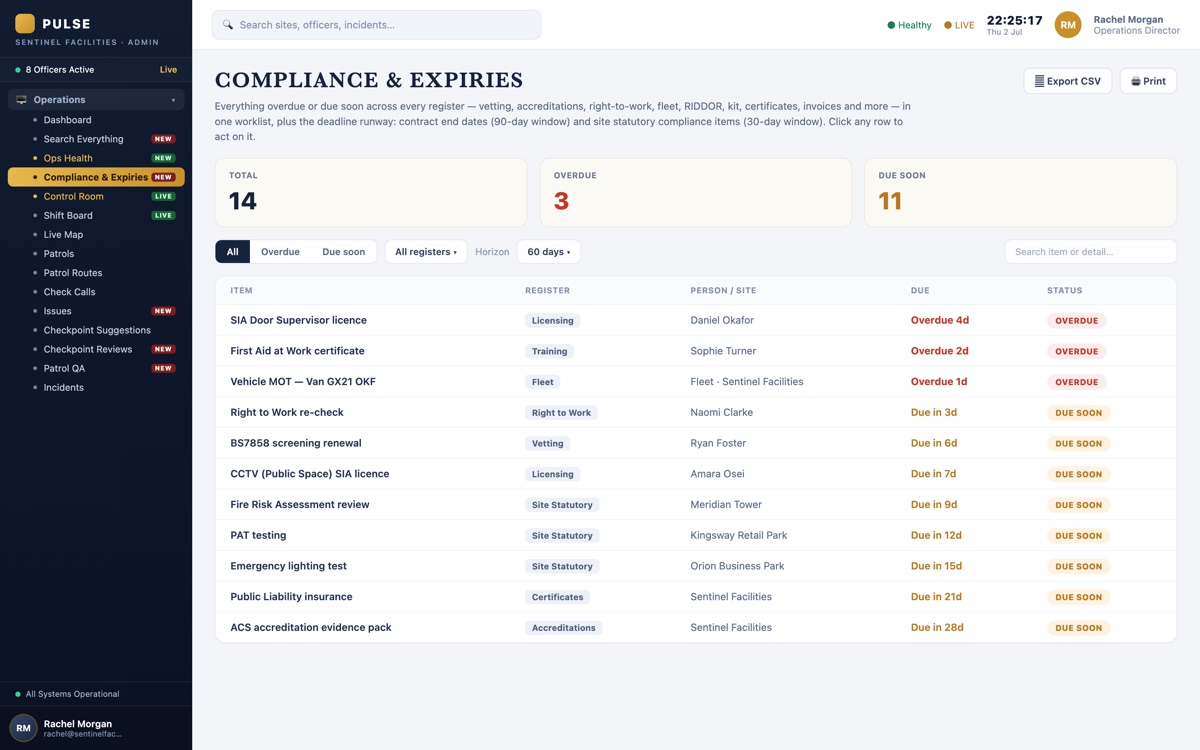
COSHH is one strand of a much wider statutory compliance burden that FM and security operators carry — SIA licensing, BS 7858 vetting, DBS checks, right-to-work documents, and increasingly Martyn's Law readiness under the Terrorism (Protection of Premises) Act 2025 all sit on the same risk register as hazardous substance control. The problem is rarely a lack of policy; it's producing the evidence trail an inspector or client actually asks for, on the day they ask for it.
Pulse Operations built its compliance runway to solve exactly this: SIA, BS 7858, DBS, right to work, training records, statutory building compliance and Martyn's Law assessments tracked on one expiries timeline rather than scattered across spreadsheets and inboxes. "The assessors' pain is archaeology — records scattered across inboxes and cabinets. Run the operation in one system and the evidence assembles itself as a by-product of the work. Assessment prep should be an export, not an excavation," says Mo Hassan, Founder, Pulse.
The same discipline applies whether you're proving a COSHH-trained cleaning team or a vetted security guard. If your business is carrying COSHH, BS 7858 or Martyn's Law duties across multiple sites, get a quote from Pulse Operations or book a call to see the compliance runway in action.
Related Reading
- Asbestos Management Penalties for Non-Compliance UK 2026
- Building compliance checklist UK: 2026 duty-holder guide
- Fire Alarm Testing Frequency UK: 2026 Compliance Guide
Add pulse-operations.co.uk as a preferred source on Google
Back to all insights