Last updated: 1 September 2026
Guard tour software: the UK buyer's guide for 2026
Guard tour software is a digital system that replaces paper patrol logs and mechanical watchclocks with app-based checkpoint verification, GPS tracking and real-time reporting. In the UK, the strongest systems now verify presence with a timestamped, geotagged photograph rather than a tag scan — and the global market for these platforms is forecast to keep growing at close to 10% a year through the mid-2030s.
Key Takeaways
- Guard tour software replaces paper logs and watchclocks with app-based checkpoint verification, incident logging and live reporting for security patrols.
- Over 70% of the security guard industry now uses some form of mobile guard tour software for officer management, according to GuardMetrics (2026).
- Cloud-based guard tour systems can cut upfront IT costs by roughly 30%, speed incident response by around 25%, and reduce liability claims by 15–20%, per GuardPatrolling.com (2026).
- The global guard tour systems market is projected to grow from USD 3.61 billion in 2026 to USD 9.18 billion by 2035, a CAGR of 9.78%, according to Spherical Insights & Consulting (2026).
- Pulse Operations records 96.2% of checkpoints with a watermarked photo across live operations in the trailing 90 days, as of July 2026 (see /benchmark).
What is guard tour software?
Guard tour software is a digital platform that records, verifies and reports on security patrols, replacing the mechanical watchclock and the paper occurrence book. An officer carries a phone app rather than a clipboard; the app captures each checkpoint visit, timestamps it, and pushes the record to a control room and a client-facing dashboard in real time.
Most systems on the market today rely on NFC tags or QR codes fixed at each checkpoint — the officer taps or scans the tag with a phone to log the visit. Pulse Operations builds its officer app around a different mechanism entirely: a mandatory watermarked photograph, stamped with the officer's name, the site, GPS coordinates and the time, completes the checkpoint. There is no tag to scan by design.
This matters because a scan proves a phone was near a tag. It doesn't prove a person looked at anything. That distinction sits at the heart of how Pulse Operations's guide on proving patrols actually happened frames the whole category.
How the market got here: from watchclocks to apps
The Wikipedia entry on guard tour patrol systems traces the technology's evolution from mechanical watchclocks, through RFID and NFC tags, to GPS- and QR-code-based verification. Each generation solved the previous one's weakest point — but tag-based systems left a gap that the industry is only now closing: a tag scan can be completed in seconds without the officer actually inspecting the area, and tags themselves get painted over, ripped off, or lose signal in basements and plant rooms.
How does guard tour software actually work?
A typical guard tour software deployment has four moving parts: a mobile officer app, a set of digital checkpoints mapped across the site, a control room dashboard, and a reporting layer that clients or managers can see. The officer walks a defined route; at each checkpoint the app captures proof of the visit — a scan, a GPS ping, or a photograph — and syncs it, either instantly or once signal returns.
The differences between vendors sit almost entirely in what counts as "proof" and what happens when a phone loses signal. Pulse's officer app is offline-first with self-healing sync, meaning patrols recorded in a basement with no signal queue locally and upload automatically the moment connectivity returns — nothing is lost, and no officer has to remember to resend anything.
Checkpoint verification: photo versus tag scan
This is the single biggest design decision in any guard tour software, and it's worth setting out plainly.
A tag scan tells you a phone was held near a tag at a moment in time. It does not tell you that a person was genuinely present and alert, and it can be defeated in seconds — tags can be scanned on the way past without the officer stopping, or scanned from a photo of the tag taken earlier, per Pulse Operations's guide to proving patrols. Tags also fail physically: painted over, ripped off, or sitting in a spot with no signal.
A watermarked photograph, by contrast, stamps the officer, the site and checkpoint, GPS coordinates, a precise timestamp and the actual state of the area onto the image — a secured door, a clear loading bay, an empty plant room. That is why on Pulse, the photo is the checkpoint completion. There's no separate tag to scan.
"A tag scan proves a phone was near a tag. It doesn't prove anyone looked at anything. We made the photo the completion itself — no photo, no tick — because the first time a client disputes a night's cover, a scan log is an argument and a photograph is an answer." — Mo Hassan, Founder, Pulse
Incident logging and the occurrence book
Alongside checkpoints, most guard tour platforms carry some form of incident logging. Pulse's version is a tamper-evident daily occurrence book covering 18 incident types, backed by a hash-chained (SHA-256) audit log with a built-in integrity check that walks the entire chain — so a record can't be quietly edited after the fact without the tampering being detectable.
How much does guard tour software cost in the UK?
Guard tour software in the UK is typically sold per officer per month, with pricing tiers reflecting how much of the wider operation — compliance, rostering, facilities management — is bundled in alongside patrol verification. Entry-level tiers usually cover the officer app, checkpoints and basic reporting; higher tiers add compliance tracking, white-labelling and enterprise support.
Published, per-operative pricing (rather than a quote-only sales process) is still relatively unusual in this market. Pulse publishes its tiers openly at pulse-operations.co.uk/pricing: pricing is per operative, sites are unlimited, and admin, control-room and client-portal seats are free on every plan.
| Consideration | What to check |
|---|---|
| Pricing model | Per officer/operative, per site, or per checkpoint? |
| Site limits | Are additional sites free or charged separately? |
| Admin/portal seats | Free, or charged per login? |
| Contract length | Month-to-month, or a multi-year lock-in? |
| Hosting | UK-hosted, or hosted overseas with data residency implications? |
| Migration | Guided setup included, or a separate professional-services fee? |
Two structural cost factors are worth understanding before you compare quotes. First, GuardPatrolling.com (2026) reports that cloud-based guard tour systems reduce upfront IT costs by approximately 30% compared with on-premise hardware-based systems, because there's no dedicated tag infrastructure or server to install and maintain. Second, the same source notes digital proofs of presence can reduce liability claims by 15–20% — a meaningful offset against subscription cost when a single disputed incident can cost far more than a year of software fees.
Every Pulse plan includes guided setup, migration support and a parallel run on one site before full cut-over; most firms complete the switch fully within a fortnight.
Why does proof of presence matter more than ever?
Proof of presence matters because clients, insurers and regulators increasingly expect security providers to demonstrate — not just claim — that contracted patrols happened. A signed paper log or an invoice line was once enough. It no longer is, particularly once a client has been burned by an incident on a night the log claimed was covered.
This shift is visible in how contracts are being written and re-tendered across the UK security sector. Facilities managers, residential estate boards and shopping centre operators are asking for evidence, not assurance — and Pulse Operations's guide on how to prove patrols actually happened sets out what credible evidence looks like: watermarked, timestamped photos; routes covered against what the contract specifies; and incidents logged with the time they were raised and resolved.
Case study: proving 152 checkpoints on one West London street
Priority First — the founding team's own London security and facilities operation, inside which Pulse was originally built before being offered to other operators — took on security for a mixed-use development on one of West London's best-known streets: retail units, residential cores, plant rooms and service yards. The client's concern was specific: there was no way to prove which plant room had actually been checked at 3am.
Pulse made all 152 checkpoints across the site photo-mandatory. A missed area now shows as a gap in the record immediately, rather than surfacing as a dispute six weeks later when something has gone wrong. The system has been live since February 2026; by July 2026, production data showed more than 540 patrols completed across the site in the first five months, with 11 officers inducted onto one platform.
Why the client portal changes the conversation
A portal that always reads 100% is one nobody believes. Pulse's client portal deliberately shows delivered-vs-contract with honest empty states — gaps show as gaps, not as suppressed data — because that honesty is what makes the 96%-plus figures credible in the first place. This white-label portal sits under the operator's own brand, so the security company — not Pulse — gets the credit with its client.
What should you look for when comparing guard tour software?
Choosing between guard tour platforms comes down to five practical questions: how checkpoints are verified, whether the app works offline, what happens to your data, how pricing scales as you add officers, and whether the whole operation — not just patrols — lives in one system.
Named platforms in the UK and international market include TrackTik, Silvertrac, Guardhouse and SmartTask — each has genuine strengths, and a proper comparison (pulse-operations.co.uk/compare) should weigh them on the specifics that matter to your operation, not marketing claims.
| Factor | What to ask a vendor |
|---|---|
| Checkpoint proof | Tag scan, GPS ping, or mandatory photo? |
| Offline behaviour | Does the app queue and self-heal, or does it fail silently? |
| Data hosting | Where is data hosted, and is tenant data isolated? |
| Audit trail | Can records be edited after submission without detection? |
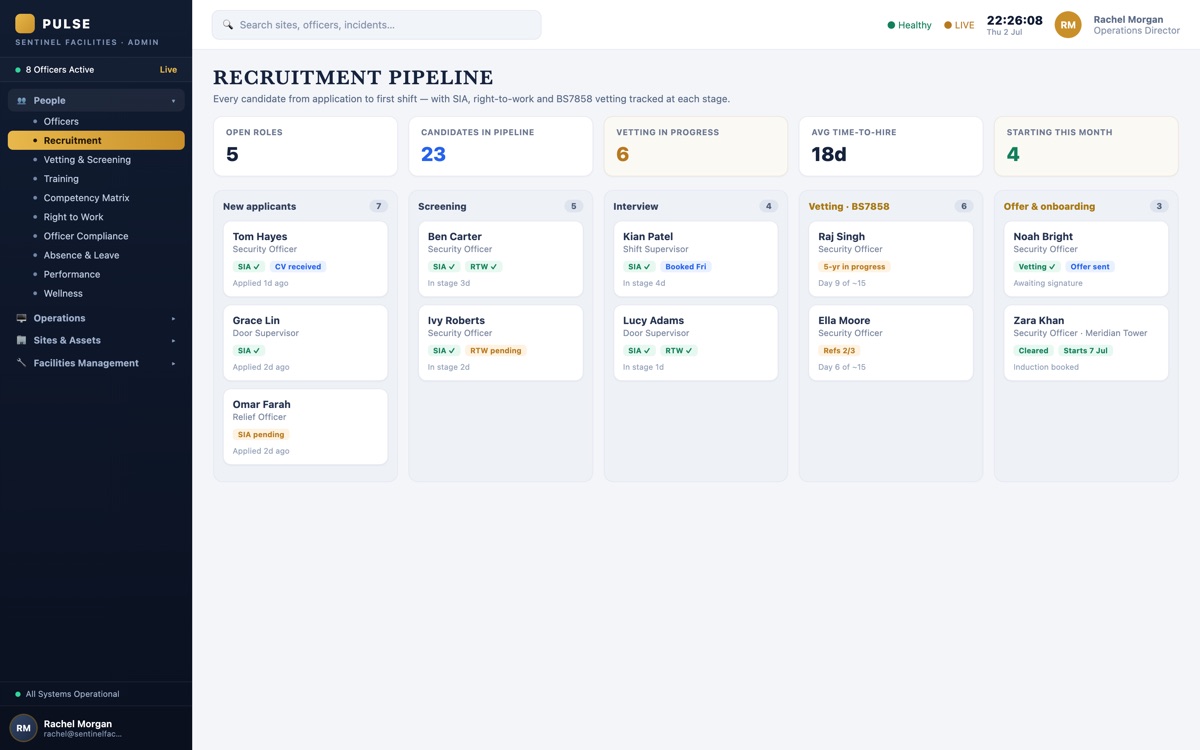
| Compliance | Does it track SIA licensing, BS 7858 screening, DBS and training expiries? |
| Facilities scope | Patrols only, or also work orders, PPM and helpdesk SLAs? |
| Pricing transparency | Published rates, or quote-only? |
Pulse's audit log is hash-chained using SHA-256 with a built-in integrity check that walks the whole chain, and the platform is UK-built and UK-hosted with tenant isolation enforced at the data layer, verified by an automated cross-tenant test suite on every build.
In-house build versus buying a platform
Some larger operators consider building patrol-tracking tools in-house rather than buying a platform. The trade-off is straightforward: an in-house build gives full control but demands ongoing engineering resource, offline-sync handling and security hardening that most security or FM businesses don't want to own. A bought platform trades some customisation for speed — most operators can be live within a fortnight rather than a multi-month build — and shifts the burden of keeping the audit trail tamper-evident, GDPR-compliant under the ICO's guidance, and continuously tested for cross-tenant leakage onto the vendor.
How does guard tour software support UK compliance?
Guard tour software supports UK compliance by centralising the records that regulators and clients actually ask for: SIA licence numbers, BS 7858 screening dates, DBS checks, right-to-work documents, training certificates and statutory building compliance — all with expiry dates visible before they lapse, not after.
The Security Industry Authority (SIA) licenses individuals working in designated security roles under the Private Security Industry Act 2001, and firms seeking Approved Contractor Scheme (ACS) status are assessed against 78 individual indicators across seven criteria — Strategy, Service delivery, Commercial relationship management, Financial management, Resource management, People and Leadership — organised into 33 sub-criteria, per Pulse Operations's guide, The ACS self-assessment: how to evidence it.
Assessors don't take self-reported scores at face value. They review staff files, payroll records, contracts and duty rotas, policies and procedures, and site documentation; they interview staff and customers; and they visit operational sites, according to the same guide. The People criterion specifically checks how well a contractor applies BS 7858 for security screening and verifies licences against the SIA's register. After the initial assessment, approved contractors are reassessed annually, and where an assessor flags improvement needs, they must be addressed within the timeframe the assessor sets.
A platform that generates checkpoint records, training expiries and screening dates as a by-product of daily operations — rather than requiring a separate annual scramble — turns that reassessment from a weeks-long evidence-gathering project into something closer to a report export. Pulse's compliance runway (/compliance) is built specifically around that expiries-first view: SIA, BS 7858, DBS, right to work, training and statutory building compliance sit on one timeline, alongside Martyn's Law assessments for premises that fall within its scope.
Martyn's Law and premises-level obligations
The Terrorism (Protection of Premises) Act 2026 — commonly known as Martyn's Law — introduces new duties on qualifying premises to assess and mitigate terrorism risk, with obligations scaling by capacity. Guard tour and patrol records feed directly into that assessment: knowing which checkpoints, entrances and public areas are actually being checked, and how often, is part of the evidence a responsible person needs to hold. Pulse's compliance runway includes Martyn's Law assessments alongside the rest of the compliance calendar rather than as a separate exercise — see Pulse Operations's guide to Martyn's Law for the detail.
Case study: 16 buildings, one nightly round, one estate
A prestige central-London residential estate ran sixteen buildings on a single nightly patrol round through Priority First — again, the founding team's own operation, transparently disclosed rather than presented as an arm's-length customer story. Multi-building rounds are exactly where patrols quietly go missing, and the estate had no way to see delivered-versus-contracted coverage without phoning the office.
Pulse set up each building as its own site with its own checkpoints and evidence trail, added recurring-findings detection to surface repeat faults automatically, and gave the estate its own portal. Since going live in March 2026, the estate has recorded more than 4,100 patrols — roughly 250 to 280 per building — with 100% of checkpoint completions photo-verified, up from a system that previously offered one vague "round complete" message per night.
Guard tour software vs traditional patrol methods
| Method | Proof of presence | Real-time visibility | Tamper resistance | Typical cost profile |
|---|---|---|---|---|
| Paper logs / watchclock | Signature or clock stamp | None until reviewed | Low — easily backfilled | Low upfront, high liability risk |
| NFC/QR tag scanning | Phone near tag at a timestamp | Near real-time | Moderate — tags can be gamed | Mid — tag hardware plus software |
| GPS-only tracking | Location ping, no visual confirmation | Real-time | Moderate | Mid |
| Watermarked photo verification | Officer, site, GPS, time, and visual state of the area | Real-time | High — photo evidence per checkpoint | Software subscription only |
Over 70% of the security guard industry now uses some form of mobile guard tour software, according to GuardMetrics (2026) — but "mobile" covers a wide spread of proof mechanisms, from basic GPS tracking through to full photo verification, so the comparison above matters more than the category label.
Your guard tour software evaluation checklist
- Confirm whether checkpoints require a photo, a tag scan, or a GPS ping — and understand what each actually proves.
- Test the app in a genuine no-signal environment (basement, plant room, lift shaft) before signing anything.
- Ask whether the audit log can be edited after submission, and whether tampering would be detectable.
- Check where data is hosted and whether tenant data is isolated from other customers.
- Request the published pricing page — a quote-only sales process is worth questioning.
- Map your SIA, BS 7858, DBS and training expiries against the platform's compliance view before go-live.
- Ask for a parallel run on one site rather than a full switch-over on day one.
- Check whether the client portal shows honest gaps or only ever reports 100%.
FAQ
What is guard tour software and how does it work?
Guard tour software is a digital system that verifies and records security patrols via a mobile app, replacing paper logs and mechanical watchclocks. Officers visit defined checkpoints; the app captures proof of the visit — a tag scan, GPS ping, or mandatory photo — and syncs it to a control room and client dashboard in real time.
What is the difference between a guard tour system and security guard management software?
A guard tour system focuses specifically on checkpoint verification during patrols — proving an officer visited a location at a given time. Security guard management software is broader, typically covering rostering, time and attendance, payroll, compliance tracking and client reporting alongside the patrol function itself. Platforms like Pulse combine both, plus facilities management, in one system.
How much does guard tour software cost?
Guard tour software in the UK is generally priced per officer per month, with tiers ranging from basic patrol verification through to full compliance and facilities management. Pulse publishes its tiers openly at pulse-operations.co.uk/pricing, with unlimited sites and free admin and portal seats on every plan — worth using as a benchmark when comparing quote-only vendors.
What features should I look for in guard tour software?
Look for photo or GPS-verified checkpoints, offline-first functionality with automatic sync recovery, a tamper-evident audit log, live incident logging, and compliance tracking for SIA licences, BS 7858 screening and DBS checks. A client-facing portal showing delivered-versus-contracted patrols is increasingly a baseline expectation, not a premium extra.
Is guard tour software suitable for small security companies?
Yes. Cloud-based guard tour systems reduce upfront IT costs by around 30% compared with hardware-based alternatives, according to GuardPatrolling.com (2026), removing the capital barrier that historically made patrol technology a large-operator advantage. Per-operative pricing models also mean small firms only pay for the officers they actually deploy.
Can guard tour software integrate with access control and video surveillance systems?
Many platforms offer integrations with access control and CCTV/VMS systems, though the depth varies significantly by vendor and is worth testing directly rather than taking on trust. Ask any vendor for a live demonstration of the specific integration you need rather than relying on a features list.
How does guard tour software improve incident response and reporting?
Real-time incident reporting through guard tour software speeds up response times by an average of 25%, according to GuardPatrolling.com (2026), because incidents are logged and escalated the moment they're raised rather than at the end of a shift. A tamper-evident occurrence book also means the incident record can't be quietly altered after a dispute arises.
What is the best guard tour software in 2026?
The best guard tour software depends on what your operation needs verified and how it's structured — a mobile patrol firm has different priorities from a shopping centre or an estates team. Compare vendors on checkpoint verification method, offline reliability, pricing transparency and compliance depth; Pulse's own comparisons against TrackTik, Silvertrac, Guardhouse and SmartTask are a useful starting point at /compare.
Proving your patrols with Pulse Operations
Every question in this guide — how checkpoints get verified, what happens when a client disputes a night's cover, how compliance evidence gets pulled together for an ACS reassessment — comes back to the same design decision: whether your system produces an argument or an answer when it matters. Pulse Operations built its guard tour software around the answer: a mandatory watermarked photograph at every checkpoint, no tag scans, on a platform that's UK-built and UK-hosted.
Across live operations, Pulse records 96.2% of checkpoints with a watermarked photo in the trailing 90 days, as of July 2026 — see the methodology at /benchmark. The system was built and proven inside Priority First, the founding team's own London security and facilities operation, before being opened to other operators.
If you're comparing guard tour software for your own patrols, mobile keyholding or estates contracts, get a walkthrough of the officer app, the client portal and the compliance runway at pulse-operations.co.uk/pricing — every tier is published, and most operators are live within a fortnight of saying yes.
Related Reading
- Security Guard Handover Template UK | Free Guide 2026
- Guardhouse Alternative 2026: Best UK Options Compared
- SmartTask Alternative 2026: Best Options Compared