Last updated: 17 October 2026
Celayix is a Canadian-built scheduling platform used by security firms worldwide, priced from $8 per user per month on its Pro plan for organisations with 25+ employees (Capterra, 2026). UK operators looking to switch typically want sterling pricing, UK data hosting, and features built for the Employment Rights Act 2026 rather than a bolt-on US scheduling tool.
Key Takeaways
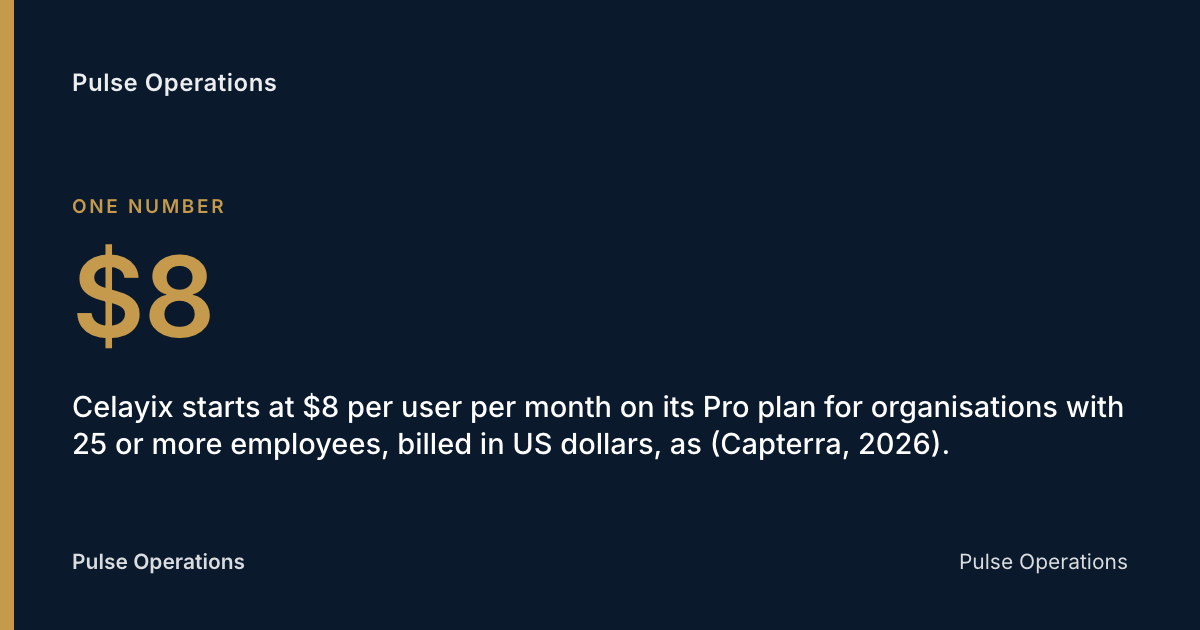
- Celayix starts at $8 per user per month on its Pro plan for organisations with 25 or more employees, billed in US dollars, as (Capterra, 2026).
- Celayix holds a 4.0 out of 5 rating on G2, but that score is based on just 12 reviews — a thin sample for a buying decision (Unrubble Blog, 2026).
- UK workforce management software fees range from roughly £5 to over £50 per user per month, depending on the tier and features included (Parim, 2026).
- The Employment Rights Act 2026 became law on 18 December 2026, introducing guaranteed hours, reasonable shift notice and cancelled-shift payments that UK scheduling software must now support (Acas, 2026).
- UK employers must keep working time records for two years from the date they were made, which any replacement platform needs to satisfy on day one (Connecteam, 2023).
What is Celayix and what core features does it offer?
Celayix is a workforce scheduling and time-and-attendance platform originally built for shift-based industries including security, healthcare and hospitality. Its core feature set covers shift scheduling, mobile clock-in/clock-out, employee self-service, and reporting designed to reduce the administrative burden of building rotas by hand.
Celayix reviewers come mostly from small businesses (52%), followed by midsize companies (32%) and enterprises (16%), with Security and Investigations the single largest use case at 26% of reviewers (Capterra, 2026). That matters for a UK reader: Celayix's product roadmap and support experience are shaped by a majority North American, small-business user base, not by UK employment law or SIA (Security Industry Authority) licensing requirements.
The platform's own marketing claims businesses can schedule thousands of shifts in minutes, recover up to $350 per employee a month, and cut schedule creation time by 95% (eLearning Industry, 2026). One verified user reviewer on GetApp said: "The allocation of employee scheduling and time attendance features in one place is what I like most about Celayix since it eradicate need for third-party Apps integration." Another wrote: "Great scheduling app that has streamlined our processes, reduced errors, and made managing employee shifts much more efficient overall."
What Celayix does not natively provide is proof-of-service for security operations — verified evidence that a specific patrol checkpoint was actually walked, at a specific time, by a specific named officer. That gap is exactly where a UK security or facilities management operator starts asking whether a scheduling tool is enough, or whether the business needs an operations platform.
Why might a UK business be looking to switch away from Celayix?
UK security and FM businesses typically look for a Celayix alternative when the platform's US-dollar pricing, thin review base, and lack of UK-specific compliance tooling stop matching how the business actually operates. Celayix's G2 score of 4.0 out of 5 is drawn from only 12 reviews (Unrubble Blog, 2026) — a sample size too small to give a UK buyer real confidence about long-term support quality or feature reliability at scale.
Three recurring triggers come up repeatedly among UK operators:
- Currency and billing friction. Celayix's headline Pro pricing is quoted in US dollars per employee per month (Capterra, 2026), which means UK finance teams are exposed to exchange-rate movement on every invoice — an unwelcome variable for a business already managing tight margins on security contracts.
- No built-in evidence trail for patrols. Scheduling who is supposed to be on shift is not the same as proving what actually happened at each checkpoint. Security contracts increasingly require photographic or GPS-stamped evidence, not just a rota.
- Compliance drift ahead of the Employment Rights Act 2026. The Act, which became law on 18 December 2026, introduces guaranteed hours, reasonable shift notice, and payments for cancelled shifts (Acas, 2026). Around 1.1 million UK workers currently sit on zero-hours contracts, and many of them work in security and cleaning — sectors where scheduling software now needs to track notice periods and cancellation payments, not just shift slots (Rebox HR, 2026).
For a business running mobile patrols, keyholding or static guarding contracts, the deciding factor is rarely "can it build a rota" — it's whether the platform can also prove delivery to the client and stand up to a Working Time Regulations audit.
What are the best Celayix alternatives available to UK businesses?
The strongest Celayix alternatives for UK security and facilities operators fall into two categories: general-purpose rota tools (Deputy, RotaCloud, Planday) and sector-specific security operations platforms (TrackTik, Silvertrac, Guardhouse, SmartTask, Pulse Operations). Which category fits depends on whether the business needs scheduling alone, or scheduling plus proof-of-service for client-facing security contracts.
General rota tools handle shift building, time clocks and basic payroll exports well, and tend to be priced competitively for retail and hospitality use cases. Security-specific platforms go further: they combine rostering with patrol verification, incident logging, and compliance tracking against standards like BS 7858 (screening and vetting for security personnel) and the SIA's licensing regime.
Pulse Operations sits in the second category, built specifically for UK security and FM companies. Rather than relying on NFC or QR tag scans to mark a checkpoint complete, Pulse Operations verifies every patrol checkpoint with a mandatory watermarked photograph capturing the officer, the site, GPS coordinates and the time — the photograph is the checkpoint completion, by design. That distinction matters directly to the "switch from Celayix" decision: Celayix schedules the shift, but it doesn't verify what the officer did once on site.
A landmark West London mixed-use development illustrates the difference in practice. Priority First — the founding team's own London security and FM operation, disclosed here because Pulse Operations was built inside it before being offered to other operators — needed to prove that plant rooms and service yards across a well-known street were actually checked overnight, not just scheduled. Pulse Operations made all 152 checkpoints on the site photo-mandatory; a missed area now shows as a visible gap in the record rather than a dispute raised six weeks later. Since going live in February 2026, the site has recorded over 540 patrols in its first five months, with 11 officers inducted on one system (production data, July 2026).
How do these alternatives compare to Celayix on pricing and value for money?
UK workforce management software pricing typically ranges from roughly £5 per user per month for basic scheduling tools up to over £50 per user per month for premium, feature-rich platforms (Parim, 2026). Celayix's Pro plan starts at $8 per user per month for 25+ employees (Capterra, 2026), which sits at the lower-mid end of that range once converted, though the USD billing itself is a factor for UK buyers to weigh.
| Platform | Pricing model | Currency | Notes |
|---|---|---|---|
| Celayix | From $8/user/month (Pro, 25+ employees) | USD | (Capterra, 2026) |
| Generic UK WFM software (range) | £5–£50+/user/month | GBP | (Parim, 2026) |
| Pulse Operations | Published per-operative pricing, unlimited sites | GBP | Admin, control-room and client-portal seats are free on every plan; see /pricing |
| TrackTik, Silvertrac, Guardhouse, SmartTask | Vary by vendor | Mostly USD/CAD | See /compare and /benchmark |
The headline per-user rate isn't the whole story. Value for money for a security business depends on what's included at that price: does it cover unlimited sites, or is there a per-site fee? Are admin and client-portal seats free, or charged per login? Pulse Operations publishes its pricing openly at /pricing, priced per operative with unlimited sites and free admin, control-room and client-portal seats on every tier — the kind of transparency a buyer comparing several vendors' quote-only pricing pages will notice quickly.
Which alternatives are best suited for UK-specific needs like GDPR and employment law?
UK-specific suitability comes down to two things: where the data is hosted, and whether the platform's scheduling logic understands UK employment law rather than US or Canadian labour rules. Under the UK GDPR (General Data Protection Regulation) and the Data Protection Act 2018, businesses handling employee personal data — including biometric clock-ins, GPS location and photographic evidence — need to know exactly where that data sits and who can access it.
Pulse Operations is UK-built and UK-hosted, with tenant isolation enforced in the data layer and verified by an automated cross-tenant test suite on every build. That's a materially different proposition to a platform hosted in North America, where UK data protection obligations around international transfers add an extra layer of due diligence for the buyer's compliance team.
On employment law, the Employment Rights Act 2026 introduces reasonable shift notice periods and payments for cancelled shifts (Acas, 2026; legislation.gov.uk). A scheduling platform built around this legislation needs to track how much notice was given for each shift and flag cancellations that trigger a payment obligation. UK law also requires employers to keep working time records for two years from the date they were made (Connecteam, 2023) — a retention requirement that any replacement platform's data export and archiving features need to satisfy without manual workarounds.
For SIA-regulated security work specifically, a platform also needs to track licence expiries, BS 7858 vetting status, DBS (Disclosure and Barring Service) checks and right-to-work documentation. Pulse Operations's compliance runway covers SIA licensing, BS 7858, DBS, right to work, training records, statutory building compliance and Martyn's Law assessments (the Terrorism (Protection of Premises) Act 2026 requirements for public venues) on one expiries dashboard — see /compliance.
What features should a UK business prioritise when choosing scheduling software?
A UK security or FM business should prioritise features that solve for compliance, proof-of-service and payroll accuracy before comparing cosmetic dashboard design. The following checklist reflects what actually changes day-to-day operations, rather than what looks impressive in a sales demo.
In-house vs outsourced decision framing: some businesses build their own spreadsheet-and-WhatsApp scheduling process rather than buying software at all. That approach avoids a monthly software fee but leaves the business exposed on two fronts — no audit trail for a Working Time Regulations inspection, and no evidence to show a client that patrols were actually delivered. For any business running SIA-licensed contracts of meaningful size, the cost of a compliance breach or a disputed invoice tends to outweigh the software fee within the first difficult incident.
Priorities to weigh:
- Offline-first mobile capability — officers working in basements, plant rooms or rural sites need an app that keeps working without signal and syncs later.
- Photographic or GPS-verified checkpoint completion — not just a scan, but evidence that stands up if a client disputes delivery.
- Tamper-evident audit logging — records that can't be quietly edited after the fact.
- UK payroll export compatibility — direct exports to the payroll systems the business already runs.
- Compliance expiry tracking — SIA licences, DBS checks, BS 7858 vetting and training certificates on one runway, not scattered spreadsheets.
- Client-facing reporting — a portal showing delivered-vs-contracted hours, so account managers aren't manually building reports every month.
How does customer support compare across UK-facing alternatives?
Support quality varies significantly between vendors built for the North American market and those built for UK operators from day one. Celayix's relatively small review base — 12 reviews on G2 (Unrubble Blog, 2026) — makes it hard to independently verify support responsiveness at scale, and time-zone differences between the UK and Celayix's Canadian base can add friction for urgent issues, such as an app outage during a live overnight patrol.
UK-hosted platforms built specifically for the security sector generally offer support aligned to UK working hours and terminology — understanding what "keyholding," "static guarding" or "mobile patrol" mean operationally, rather than translating US scheduling concepts. Pulse Operations, for example, is built inside a working London security and FM operation (Priority First), meaning support conversations start from shared operational context rather than a generic ticketing queue.
How easy is it to migrate data and switch from Celayix?
Migrating away from Celayix is generally a matter of weeks rather than months, provided the receiving platform offers guided setup and a parallel-run period. Data to migrate typically includes employee records, site and client details, historic shift patterns, and compliance documents such as SIA licence numbers and DBS check dates.
Pulse Operations includes guided setup, migration support and a parallel run on one site with every plan, and most firms complete a full switch within a fortnight. That timeline was demonstrated when Priority First mobilised three buildings in a single July fortnight: checkpoints, site notes and induction history were live in Pulse Operations before officers arrived on site, meaning new officers started with full site history from day one rather than relying on someone's memory of "how this site usually runs."
A parallel run — keeping the old system live alongside the new one for a set period — is the safest way to de-risk a mid-contract switch. It lets a business confirm rosters match, payroll exports reconcile, and officers are comfortable with the new app before switching off Celayix entirely.
Your Celayix switch checklist
- Export all employee records, shift history and compliance documents from Celayix before cancelling any subscription.
- Confirm SIA licence numbers, DBS check dates and BS 7858 vetting status transfer cleanly into the new platform.
- Check the new platform's data hosting location and tenant isolation approach against UK GDPR requirements.
- Set a parallel-run period on at least one site before switching the whole operation over.
- Test payroll export formats against your existing payroll system before go-live.
- Brief officers on the new mobile app during induction, not on their first live shift.
- Confirm the new platform tracks shift notice periods and cancellation payments ahead of Employment Rights Act 2026 provisions coming into effect.
- Set a hard cut-off date for Celayix access to avoid running two systems indefinitely.
FAQ
What is the best UK alternative to Celayix for employee scheduling?
The best alternative depends on whether the business needs general rota scheduling or sector-specific patrol verification. Security and FM operators typically look toward platforms like Pulse Operations, TrackTik, Silvertrac or SmartTask, which combine scheduling with compliance and proof-of-service features Celayix doesn't natively provide.
Is there a cheaper alternative to Celayix for small businesses in the UK?
UK workforce management software can start from around £5 per user per month for basic tiers, compared with Celayix's $8 per user per month starting point on its Pro plan (Parim, 2026; Capterra, 2026). The right comparison depends on what's bundled at that price, including whether admin seats and multiple sites are free or charged separately.
Does Celayix work well for UK-based security and facilities companies?
Celayix works reasonably well as a scheduling tool, and security firms make up the largest single reviewer segment at 26% (Capterra, 2026). It does not natively provide photo-verified checkpoint evidence, tamper-evident audit logs, or UK-specific compliance tracking against SIA and BS 7858 requirements, which many UK security contracts now expect.
What features should a Celayix alternative have for Working Time Regulations compliance?
A compliant alternative needs to retain working time records for at least two years, as UK law requires (Connecteam, 2023), and should track shift notice periods and cancellation payments ahead of the Employment Rights Act 2026 provisions (Acas, 2026). It should also produce exportable, auditable records rather than editable spreadsheets.
How much does Celayix cost compared with other scheduling software?
Celayix starts at $8 per user per month for its Pro plan with 25 or more employees (Capterra, 2026), billed in US dollars. UK-hosted alternatives typically publish GBP pricing, which removes exchange-rate uncertainty from monthly invoicing — Pulse Operations, for instance, publishes per-operative pricing openly at /pricing.
What are the main complaints about Celayix from user reviews?
Verified reviewers generally praise Celayix's combined scheduling and time-attendance features, with one GetApp reviewer noting it "eradicate[s] need for third-party Apps integration." The main limitation for UK buyers is the thin review sample — just 12 reviews underpin its 4.0 G2 rating (Unrubble Blog, 2026) — making it harder to verify support quality and long-term reliability at scale.
How long does it take to switch from Celayix to a new platform?
A full switch typically takes around a fortnight when the new platform offers guided migration and a parallel-run period. Pulse Operations includes migration support and a one-site parallel run with every plan, and cites a comparable timeline from mobilising three new buildings for Priority First within a single July fortnight.
Switching your security or FM operation onto Pulse Operations
If the reason you're reading this is that Celayix schedules shifts but can't prove what happened once officers were on site, that's precisely the gap Pulse Operations was built to close. Every checkpoint is completed by a mandatory watermarked photograph — officer, site, GPS, time — rather than a tag scan, so the evidence exists whether or not a client ever asks for it.
At a prestige central-London estate running sixteen buildings on one nightly round, Priority First moved from one vague "round complete" message to over 4,100 photo-verified patrols since March 2026 — roughly 250 to 280 per building — with the estate able to check delivered-vs-contracted hours in its own portal instead of ringing the office (production data, July 2026; disclosed here as Pulse Operations's own founding operation).
If you're comparing Celayix against a platform built specifically for UK security and FM contracts, take a look at /vs-tracktik, /vs-silvertrac or /vs-smarttask for direct comparisons, check /pricing for the published rates, or book a walkthrough via /tour to see the officer app and client portal before you commit to a switch.
Related Reading
- Best TrackTik Competitors 2026: UK Buyer's Guide
- Silvertrac Alternative 2026: Best UK Options Compared
- Guardhouse Alternative 2026: Best UK Options Compared
Add pulse-operations.co.uk as a preferred source on Google
Back to all insights